Air lost before it reaches the room
Gaps at joints let heated and cooled air escape into attics and crawl spaces. Sealing keeps that air in the ducts, where it belongs.
Sealing ductwork is plain work with a visible payoff: closing the gaps where heated and cooled air escapes before it reaches the rooms. Leaky ducts sit behind many comfort complaints in older Denver homes, where joints have opened and tape has given up. Call (720) 806-7634 to book an inspection.
Call (720) 806-7634 to book a duct inspection. Lion Tech Home Services finds the leaks, seals them, and tests the result.
Call Now (720) 806-7634 → Open 24 hours · 7 days a week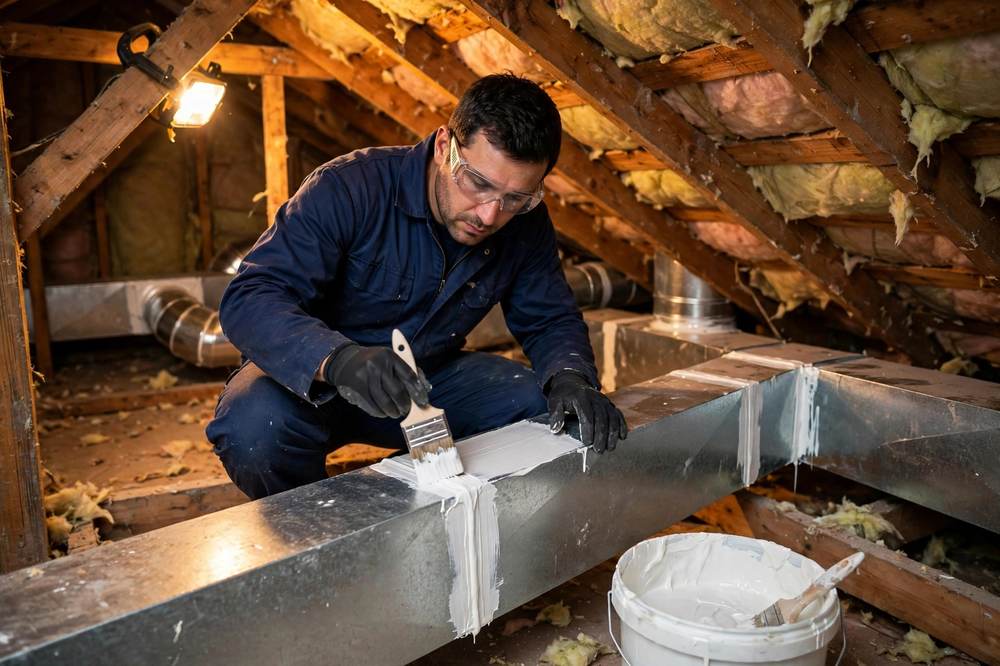
Duct sealing means finding the gaps in ductwork, at joints, seams, register connections, and where ducts meet the equipment, and closing them with mastic sealant so the air a system heats or cools actually arrives in the rooms.
Most duct systems leak somewhere. Joints open as a house settles, tape peels with heat and age, and connections at the furnace or air handler are often left unsealed. Air is lost into attics, crawl spaces, and wall cavities, while dusty unconditioned air is drawn in through the returns. Sealing proceeds joint by joint, and the change shows at the registers.
A sealing job is methodical: locate every leak, close it, then test the result.
Accessible runs are looked through for gaps at joints, seams, and connections, with the worst leaks noted first.
Joints and seams are sealed with mastic, which stays flexible and holds where tape peels and fails.
Ducts are sealed where they meet the register boots, a leak point that is easy to overlook.
Connections at the furnace, air handler, or heat pump are sealed, since large gaps often hide there.
Return runs are sealed too, so the system stops drawing dusty air from attics and crawl spaces.
Airflow at the registers is measured before and after sealing, so the improvement is measured rather than guessed.
The accessible ductwork is walked and leaks at joints, seams, and connections are noted.
Air at the registers is measured to see how much the rooms are actually receiving.
Mastic is applied to every gap found, starting with the worst leaks and the connections at the equipment.
Register boots and return connections are sealed, where leaks are common and easy to reach.
Airflow is measured again and a note is left of what was sealed and what the readings show.
Sealant and testing instruments that close leaks for good and prove the result.
Brush-on sealant that fills gaps and stays flexible, so joints remain sealed as the house moves.
Makes small leaks at joints visible so none are missed during the inspection.
Reads air at each register before and after sealing, so the gain is real.
Sees inside runs to find gaps and disconnections invisible from outside.
Used on straight seams where it belongs, with mastic doing the work at joints and connections.
Confirms the system is not working against excessive pressure once the ducts are tightened.
An older duct system leaked at joint after joint. Rooms at the ends of the runs barely received air, and the system ran long to compensate.
Once sealed, airflow at the far registers rose noticeably and the system cycled normally again.
Return ducts in the attic drew in dusty air, and the vents showed it. The filter clogged quickly and the air felt stale.
Sealing the returns stopped the dusty air at its source, and the filter now lasts its normal interval.
One bedroom ran cold every winter. Its run leaked at three joints before the air ever reached the room.
Sealing those joints restored the air to the bedroom, and it now holds temperature with the rest of the house.
Duct leaks are quiet: they make no noise, they only cost comfort. Sealing takes on these four.
Ask a pro →Gaps at joints let heated and cooled air escape into attics and crawl spaces. Sealing keeps that air in the ducts, where it belongs.
Leaky returns draw in air from unconditioned spaces. Sealing the returns keeps that air out of the rooms.
When a run leaks along its length, the room at the end gets the least. Sealing the run restores the air it was designed to carry.
Leaks force longer run times to hold temperature. Tighter ducts let the system reach the setpoint and rest.
Lion Tech Home Services seals ductwork in Denver homes from 7575 E 29th Pl #4052, testing airflow before and after.
Lion Tech Home Services holds a 5.0-star rating from 11 Google reviews.
“Absolutely excellent service - very responsive and able to work until the job is done right. Was super impressed by the support on our fireplaces and furnace - nice to have all up and working again! Many thanks”
John-Erik EmmetsbergerGoogle review
✓ VerifiedHot and cold rooms, weak airflow at a register, dust around vents, and a system that runs longer than it should are the usual signs. An inspection with airflow readings confirms it.
Mastic sealant, brushed onto joints and seams. It fills gaps and stays flexible, so it holds where tape peels off with heat and age.
It depends on how much ductwork is accessible and how many leaks there are. Many homes are sealed in a day. The scope is confirmed after the inspection.
Sealing the return ducts stops the system pulling dusty air from attics and crawl spaces. It will not remove dust already in the home, but it cuts a major source of it.
Call (720) 806-7634 to book a duct inspection. Lion Tech Home Services will find the leaks, seal them, and test the result.
Call (720) 806-7634 →Lion Tech Home Services, Denver — call (720) 806-7634, open 24 hours.