Furnace blowing cold air with the blower running
Igniter, flame sensor and gas valve are tested to find why the burners never light. A dirty flame sensor or a failed igniter is the usual cause, and both are checked first.
When the furnace stops heating, the house cools down fast on a Denver winter night. Furnace repair starts with finding the actual fault — ignition, gas valve, blower, flame sensor or controls — and explaining what failed before anything is fixed.
Lines are open 24 hours, 7 days a week. Ring (720) 806-7634, say what the furnace is doing, and the visit is talked through from the symptoms.
Call Now (720) 806-7634 →Phone-only booking — describe the fault and the visit is set.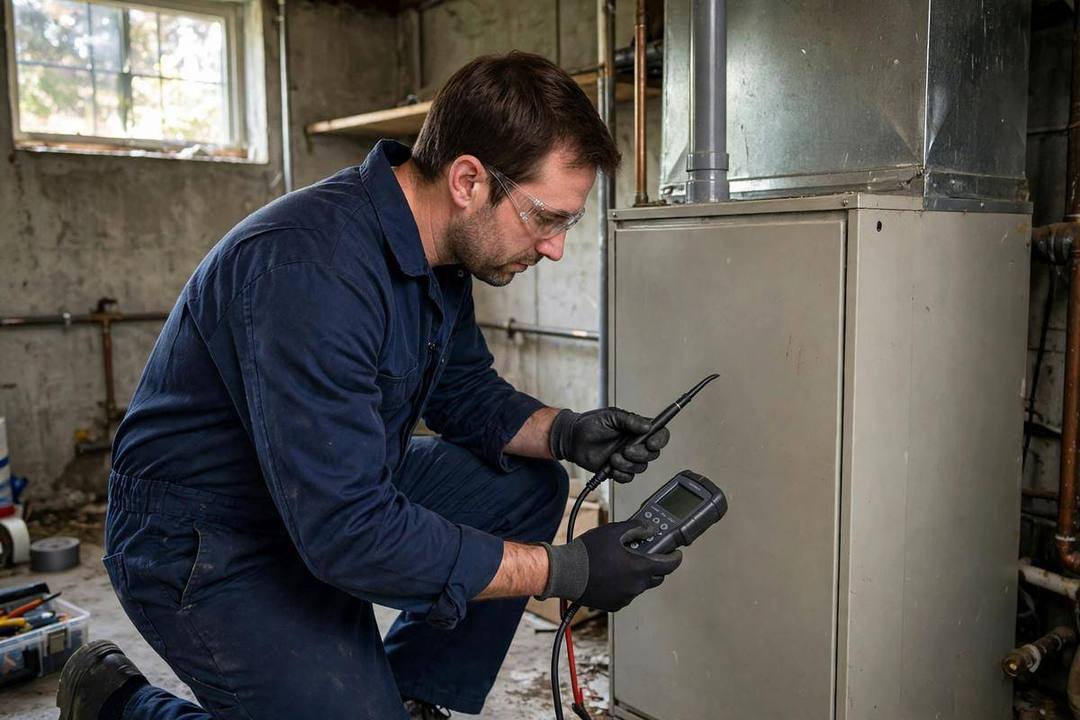
Repair is diagnosis plus the mechanical work that gets heat back: a furnace that stops firing, blows cold air, or keeps switching on and off. The visit starts at the unit — ignition system, gas valve, blower motor, flame sensor, controls — then heat exchanger and flue.
Denver furnaces carry a heavy heating load, around 6,000 heating degree days a year in a cold-dominant climate, and thin air at 5,280 feet changes how gas equipment burns. Sizing and combustion have to be set for altitude rather than sea level. Older forced-air systems in Denver's mid-century neighbourhoods are the ones that most often need a diagnosis rather than a guess.
Find the fault, explain it plainly, fix what failed, test a full heat cycle before leaving. Every visit follows that shape.
Igniter, flame sensor, gas valve, inducer motor and blower are tested, and heat exchanger and flue checked. The point is finding the real fault instead of swapping parts and hoping.
A combustion check measures carbon monoxide at the supply plenum and confirms the furnace vents as it should. A cracked heat exchanger or blocked flue is a safety matter, not a comfort one.
Igniters, flame sensors, capacitors, blower motors, inducer assemblies, gas valves and control boards fail most often. When the failed part is one Lion Tech Home Services carries, the repair finishes on the visit.
A clogged filter or dirty blower wheel sits behind many short-cycling calls. Static pressure is checked, the blower looked at, and the filter changed when loaded.
After the fix, the furnace runs a full heat cycle and temperature rise is checked against the maker's range, then every gas joint is checked with a leak detector.
A written note of the diagnosis and the parts used stays with you — useful at resale and for insurance records.
Ring (720) 806-7634 and describe what the furnace is doing — no heat, cold air, short cycling, a new noise, a smell. If you smell gas, leave the house first and call 911 or the gas company; do not stay inside to make the call.
The blower door is opened, heat exchanger inspected, and ignition system, flame sensor, gas valve and blower motor tested. A combustion check looks at carbon monoxide and flue temperature.
Before anything is fixed, you hear what failed, why it failed, and what the fix involves — in ordinary words, with the failed part shown where possible. Two failed parts means hearing about both.
Once agreed, the part is replaced and the furnace runs a full heat cycle. Temperature rise is checked, and gas joints are checked with a leak detector.
What failed and why is shown to you, the air filter changed if it was clogged, and the thermostat set together. Later questions go to the same number.
Diagnosis rests on readings, not guesses. These instruments take them.
It measures carbon monoxide, oxygen and flue temperature to confirm the furnace burns clean and vents correctly. A cracked heat exchanger or blocked flue is caught this way.
It tests voltage and amp draw at the igniter, flame sensor, blower motor and control board. Amp readings show whether a motor is wearing out before it stops entirely.
It checks gas pressure at the valve and confirms the furnace fires at its rated input. Wrong gas pressure causes rumbling, sooting and a short heat exchanger life.
It checks every gas joint after a repair to confirm there is no leak. Lion Tech Home Services never leaves a furnace until the detector is quiet at the valve, manifold and burners.
It lets Lion Tech Home Services look inside the heat exchanger and flue passages for cracks and blockages that cannot be seen from outside.
They measure airflow through the system. Restricted airflow sits behind many short-cycling and overheating calls, and the reading tells Lion Tech Home Services where the restriction is.
A bungalow in Denver has a furnace that runs but only moves cold air. The thermostat is set correctly and the filter was changed recently.
Igniter, flame sensor and gas valve are tested to find why the burners never light, and the control board is checked for fault codes.
A two-stage furnace in Denver short-cycles and the house never reaches the thermostat setting. Heating bills have crept up over the winter.
Air filter, blower wheel and static pressure are checked, then limit switch and capacitor tested. Clearing an airflow restriction often settles the cycling.
A rental in Denver loses heat whenever the furnace tries to start, and the breaker trips at the panel each time.
Blower motor amp draw is tested, wiring inspected, control board checked for burn marks before anything is replaced.
No-heat calls mostly follow a few familiar patterns. These are the ones seen most across Denver, and the way each is approached.
Ask a pro →Igniter, flame sensor and gas valve are tested to find why the burners never light. A dirty flame sensor or a failed igniter is the usual cause, and both are checked first.
Short-cycling is usually airflow or a high-limit trip. Air filter, blower wheel and static pressure are checked, then limit switch and capacitor tested.
Blower motor amp draw is tested, wiring inspected, control board checked for burn marks. A motor drawing over its rated amps is replaced before it damages the board.
If you smell gas, leave the house and call 911 or the gas company from outside. For rumbling, burners are cleaned, gas pressure checked, heat exchanger inspected. Delayed ignition should not wait.
Denver is a furnace-first market: gas forced-air furnaces dominate the post-1945 ducted stock, and with around 6,000 heating degree days a year the furnace is the system a Denver winter leans on hardest.
All eleven of Lion Tech Home Services' Google reviews are five stars — a 5.0-star rating.
“Martin does great work, is very transparent about costs, and most importantly backs up his work and will double back if needed without a question. I'll absolutely be using Lion Tech again when I need help around my homes.”
Dominic East — Google review
A furnace blowing cold air usually means the flame sensor is dirty, the igniter has failed, or the gas valve never opens, so the blower runs without heat. It can also be a tripped furnace breaker or a thermostat set to FAN ON instead of AUTO. Each one is tested in turn.
It turns on what failed and what the fix involves. A flame sensor and a control board are very different jobs, so the diagnostic comes first and you hear what is wrong and what the repair involves before any work begins. Ring (720) 806-7634 and describe the symptoms.
Check that the thermostat sits on HEAT and AUTO, the furnace switch is on, and the filter is not clogged. If you smell gas, do not keep checking — leave the house and call 911 or the gas company from outside.
Lion Tech Home Services fixes furnaces across Denver, from Baker and Capitol Hill to Park Hill and Central Park. The office is at 7575 E 29th Pl #4052, Denver, CO 80238, and the phone is answered around the clock at (720) 806-7634.
A cold house is not something to sit with. Ring (720) 806-7634, describe what the furnace is doing, and the next step gets talked through.
Call (720) 806-7634 →Lion Tech Home Services, Denver — call (720) 806-7634, open 24 hours.