Cooling that fades every summer
One floor cool and the other warm usually traces to sizing or ductwork, not the condenser alone. Load calculation and duct check come before any equipment choice.
A new air conditioner has to fit the house it cools. Denver's altitude cuts cooling capacity, the summers run into the 90s, and many homes have ductwork that was built for heating first — so sizing, ductwork and airflow are checked before anything is installed.
Open 24 hours, 7 days a week. Ring (720) 806-7634, describe the house and the cooling it has today, and the conversation starts there.
Call Now (720) 806-7634 →Phone-only booking — ring to talk the house through.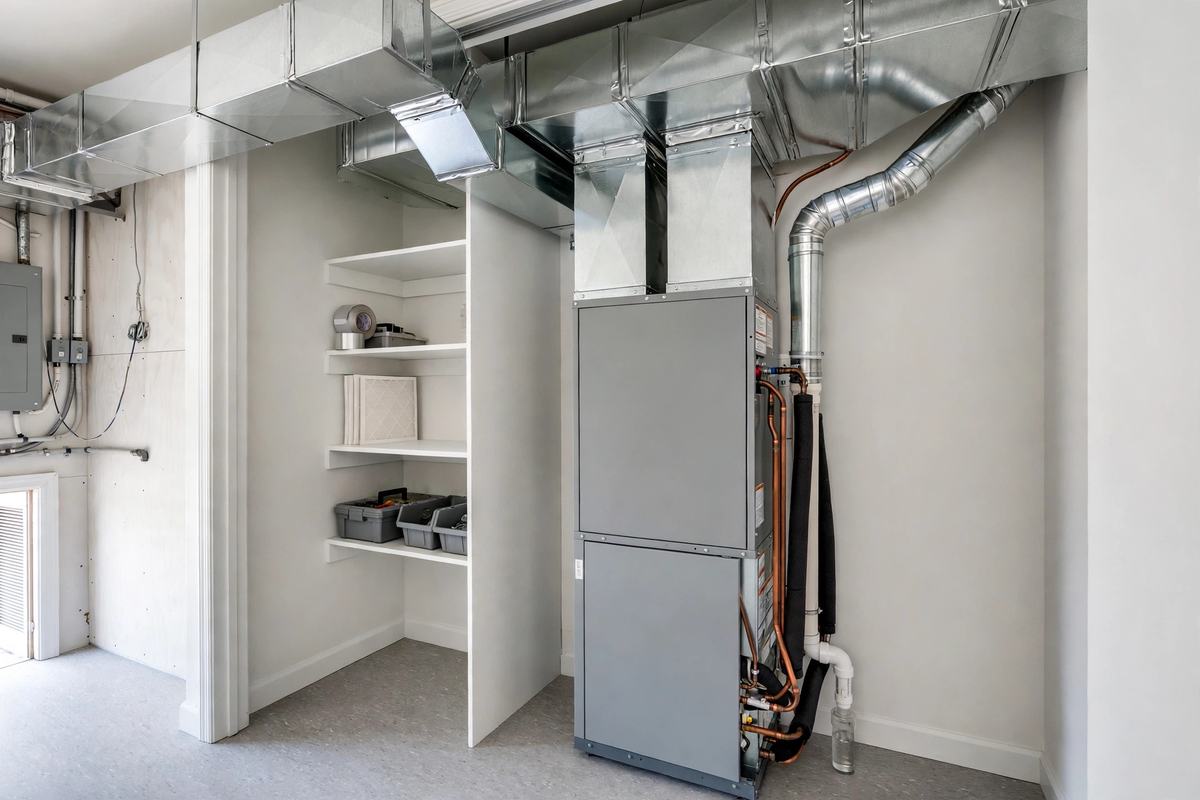
Fitting a new central cooling system means four pieces working as one: outdoor condenser, indoor coil, refrigerant lines, and the tie-in to the ducts and thermostat already in the house. Sizing decides whether rooms cool evenly or the unit cycles all summer.
Altitude shapes the job. Summer highs reach the 90s, cooling degree days run only around 750 a year, and air at 5,280 feet trims capacity by roughly a tenth to a seventh. Square-footage sizing fails here — the load gets calculated for the actual house in Denver or Denver.
Equipment, connections, and the tests that prove the house cools evenly — all part of the job.
Windows, orientation, insulation and ceiling height are measured, and the unit is sized to the load that results. Too big short-cycles and leaves air clammy; too small never catches up.
The condenser goes on a level pad with clear air around it, away from dryer vents and the worst of the dust. Clearance counts for more in a dry Denver summer than most places.
The evaporator coil is fitted to the air handler or furnace already there, and the condensate drain is run so water leaves the house instead of collecting in a pan.
Copper lines go in, get pressure-tested and evacuated, then charged to the maker's figures. A charge set by guess never cools as built.
Where supply and return meet the air handler, joints are inspected and sealed so cooled air reaches rooms rather than the attic.
Once fitted, the system runs a full cooling cycle and the drop is checked at the coil and at the registers, room by room, before anyone leaves.
Ring (720) 806-7634 and describe the cooling you have — or do not have — and the house around it. The conversation covers whether a new system fits and what the work looks like.
A visit follows: the existing system and ducts are looked over, the house is measured, and the load calculation is done. You hear which sizes fit and the reasons.
On installation day the old equipment comes out and is taken away, the condenser and coil go in, lines are run, and the system is pressure-tested, evacuated and charged.
A full cooling cycle runs and the temperature drop is checked at the coil and the registers, so uneven rooms show up that day rather than in July.
Martin walks the new system through with you — where the filter lives, how the thermostat works — and a written note of the equipment fitted and the work done stays behind.
Sizing and proof both rest on measurement, from the first visit to the final test. These instruments do the measuring.
It models cooling load from windows, orientation and insulation, so the size fits the house instead of a square-footage guess.
While the system charges, pressures are read so the refrigerant matches what the maker specifies at Denver altitude.
It pulls air and moisture out of the lines before charging. Moisture left inside damages the compressor from within.
It checks every joint once the lines are charged. A system that holds charge on the day holds it through the summer.
The drop is measured at the coil and again at the registers, room by room, as proof the cooling reaches everywhere evenly.
They measure airflow through the ducts so the new system never fights undersized or leaky runs from day one.
A brick home in Denver has a furnace and ducts but no air conditioning at all. The family has managed summer with window units and wants whole-home cooling.
Load calculated for the house, coil fitted to the air handler already there, condenser placed with clear air around it.
In Denver, an old system cools the ground floor and leaves the upstairs warm every afternoon.
Duct connections and airflow are checked at the unit, the system is sized to the load, and the drop is tested at the registers room by room.
In Denver, the condenser has failed outright and the indoor coil is as old as the unit that fed it.
Both pieces are replaced together, so the new condenser never has to work against a coil that cannot match it, and the lines are pressure-tested and charged to the maker's figures.
Homeowners weigh a new system when a pattern keeps repeating. These are the patterns that point that way.
Ask a pro →One floor cool and the other warm usually traces to sizing or ductwork, not the condenser alone. Load calculation and duct check come before any equipment choice.
On, off, on again every few minutes wears parts out and leaves air clammy. That short cycling is the classic sign of a unit too large for the house.
A condenser needing a major part every summer, on a system past its working life, costs more in repairs than the pattern justifies. History is weighed against age and condition.
Ducts built for heating alone often cannot move enough air for cooling. Supply and return connections are inspected at the unit before the new system is sized.
Around 750 cooling degree days a year shape Denver's cooling season: short, hot, and dry, with summer highs regularly into the 90s — a new system is sized for those weeks, not for an average day.
The Google rating for Lion Tech Home Services reads 5.0 stars, drawn from 11 reviews — all of them five stars.
“Martin was great! Timely, knowledgeable, and his experience showed. He was able to fix our HVAC that had been having trouble on and off for awhile. Pricing was good and reasonable! Would certainly recommend!”
Julie — Google review
Through a cooling load calculation: the house is measured — windows, orientation, insulation, ceiling height — and Denver's altitude is counted in. Air at 5,280 feet cuts capacity by roughly 10–15%, so a sea-level size would be wrong here.
Most of it turns on the size the home needs, plus the state of the ducts, the electrical supply and the pad beneath the condenser. A visit and a load calculation come first, and the work is explained before anything is booked.
Often. Where a furnace and ducts already exist, the coil fits to the air handler. Ducts get checked at the unit first, since heating ducts do not always carry enough air for cooling.
The old unit is lifted out and carried away as part of the job. The space is left tidy, and a written note of the new unit and the work done stays with you.
Ring (720) 806-7634, describe the house and the cooling it has today, and the conversation starts from there.
Call (720) 806-7634 →Lion Tech Home Services, Denver — call (720) 806-7634, open 24 hours.