Repairs coming one after another
One major part every winter says more than any single breakdown. Repair history is set against the unit's age and condition.
A new furnace is a twenty-year decision, and the sizing matters more than the badge on the box. Denver sits at 5,280 feet, so a furnace has to be sized and set up for altitude — a sea-level rule of thumb will oversize it.
Day or night, the phone is answered. Ring (720) 806-7634, describe the current furnace and the house, and the repair-or-replace question gets talked through.
Call Now (720) 806-7634 →Phone-only booking — ring to talk the house through.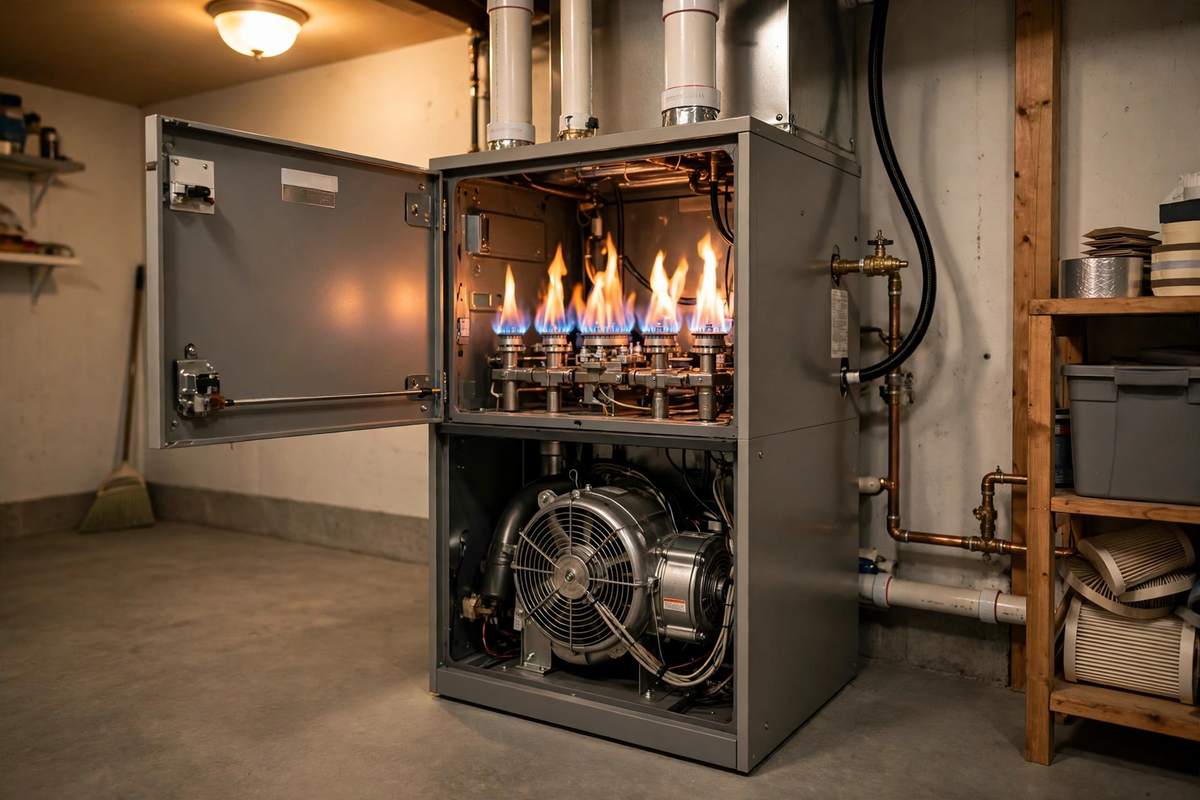
A furnace install replaces the home's heating unit outright: old furnace out, new one sized to the home's actual heat load, flue, gas line, duct connections and thermostat fitted. Sizing is the part that decides whether the house heats evenly or short-cycles all winter.
Denver's heating load is why sizing is done carefully. Around 6,000 heating degree days a year, winter design temperatures near 1°F, and air at 5,280 feet derating gas equipment by roughly 4% per 1,000 feet of altitude. A furnace sized on floor area alone comes out wrong for a house in Denver or Denver.
Unit, connections, and the tests that prove the house heats evenly. Here is what belongs to the job.
Insulation, windows, orientation and ceiling height are measured, and the furnace is sized to the heat load. Too big short-cycles; too small never catches up on the coldest nights.
The new unit is set, levelled and connected, and the flue is run so combustion gases vent correctly. Flue sizing matters at altitude, where draft behaves differently than at sea level.
Gas line connected and checked with a leak detector at every joint, and electrical supply, thermostat wiring and safety controls connected and tested.
Supply and return connections are inspected and sealed where they meet the furnace. Leaky connections at the unit waste heat into the basement or crawlspace.
Thermostat installed or reconnected, programmed together, and checked so the furnace answers a call for heat as it should.
After the install, the furnace runs a full heat cycle, temperature rise is checked against the maker's range, and the house is walked with you to confirm even heat.
Ring (720) 806-7634 and describe the current furnace — age, faults, the house itself. The conversation covers whether repair or replacement makes more sense for your situation.
A visit follows: the existing furnace and ductwork are looked over, the house measured for the load calculation. You hear which sizes fit and the reasons, and what the work involves.
On installation day the old furnace is lifted out and carried away, the new unit set and connected — flue, gas line, ductwork, thermostat — and every gas joint leak-checked.
The furnace runs a full heat cycle, temperature rise is checked, and airflow is balanced across rooms so far bedrooms heat the same as the living room.
Martin walks the new system through with you — where the filter lives, how the thermostat works — and a written note of the unit fitted and the work done stays behind.
An installation is only as good as its measurements. These tools decide the sizing and prove the result.
It models heat loss room by room from insulation, windows and orientation, so the furnace size fits the house instead of a square-footage guess.
The analyser confirms the new furnace burns cleanly and vents correctly once it is running, using carbon monoxide and flue temperature readings.
It sets gas pressure at the valve to the maker's specification. At Denver altitude, pressure has to be set for the air the furnace actually breathes.
It checks every gas joint after the install. A silent detector at the valve, manifold and burners is the standard before anyone leaves.
They measure airflow through the ductwork so the new furnace never fights undersized or blocked ducts from its first day.
They confirm the unit sits level for proper condensate drainage and that the flue has the fall and clearance it needs to draft.
In Central Park, a furnace from the early 1990s has needed two repairs in two winters, and its heat exchanger is showing its age.
Unit condition, repair history and ductwork are considered together, and the discussion covers whether another repair or a replacement is the sensible call for that house.
A two-storey in Denver heats the ground floor well, but upstairs bedrooms stay cold even with the thermostat turned up.
Ductwork and airflow are checked as part of the sizing visit. A new furnace alone never fixes a duct problem, so the ducts join the conversation.
A brick home in Capitol Hill has a furnace that runs constantly on the coldest nights and still falls short of the thermostat setting.
Heat load is calculated at altitude. A unit sized for sea-level conditions often comes up short in a Denver winter once the derate is counted.
An old furnace does not always need replacing. Some patterns point that way, and these are the signs weighed with homeowners.
Ask a pro →One major part every winter says more than any single breakdown. Repair history is set against the unit's age and condition.
A heat exchanger with cracks or corrosion is a safety matter. A combustion check finds the damage, and a damaged exchanger usually ends the repair conversation.
Cold bedrooms and a warm living room often mean furnace and ductwork no longer suit each other. Sizing and airflow are checked together before anything is decided.
A furnace losing efficiency shows up first on the gas bill, before any breakdown. Combustion and airflow are examined to see how much of the loss sits in the unit itself.
Denver's heating season runs to around 6,000 heating degree days a year, with winter design temperatures near 1°F — a furnace here is the house's hardest-working system, and its sizing is done for those nights, not for an average week.
Five stars from 11 Google reviews — that is the full record for Lion Tech Home Services.
“Martin was very prompt in responding to our requests and completing the work on a timely basis. His expertise is HVAC but he is very capable in all home maintenance areas. We have complete confidence in Martin's abilities and work and will call on him for any future projects we might have.”
JERRY SUNDBY — Google review
Through a load calculation: the home is measured — insulation, windows, orientation, ceiling height — and Denver's altitude is counted in. Gas equipment loses roughly 4% of rated output per 1,000 feet of elevation, so a sea-level size would come up short here.
Most of it turns on the size the home needs, plus the efficiency of the unit and the state of flue, gas line and ductwork. A visit and a load calculation come first, and the work is explained before anything is booked. Ring (720) 806-7634 to talk it through.
Often it makes sense to look at both together, since they share blower and ductwork. Age and condition of each are checked, and the conversation covers whether doing them together or separately fits your house.
The old unit is lifted out and carried away as part of the job. The space is left tidy, and a written note of the new unit and the work done stays with you.
Ring (720) 806-7634, describe the current furnace and the house, and the repair-or-replace question gets talked through.
Call (720) 806-7634 →Lion Tech Home Services, Denver — call (720) 806-7634, open 24 hours.